
Guide to Understanding VA Math
The Department of Veterans Affairs does not determine disability ratings for multiple conditions through ordinary addition. Instead, it uses a table based on a more complex formula. This method often produces a lower combined rating than many Veterans expect. For example, combining two 40% ratings does not result in an 80% disability rating. Under VA math, those same ratings may result in a combined rating closer to 60%.
This approach is based on the VA’s “whole-person” concept. Each rating is applied step by step, reducing the Veteran’s remaining efficiency level rather than being added to the original total.
It is not uncommon for Veterans to find this process frustrating. Learning how VA math works is the first step in understanding how your combined rating is determined and helps remove the uncertainty that often leads to that frustration.
Table of Contents
- What Is VA Math?
- What Are the Most Common Disabilities Veterans Deal With?
- How to Use the VA Combined Rating Table
- How the VA Rounds Ratings
- How Does VA Math Work for Multiple Disabilities?
- Examples of VA Math for Combined Ratings
- How VA Math Affects Your Disability Compensation
- Why Is VA Math Important to Understand?
What Is VA Math?
VA math is the system the Department of Veterans Affairs uses to combine multiple disability ratings into a single combined rating. When calculating your VA disability, the VA does not simply add the percentages together.
Instead, the VA starts with the idea that every Veteran is 100% able-bodied, or “whole,” before any service-connected conditions are applied. It then takes each rating from the remaining portion of that total, not from the original 100%.
For example, if you receive a 30% disability rating, you are considered 30% disabled with a 70% efficiency level remaining. If you then receive an additional 10% rating, the VA takes 10% of the remaining 70%, not the original 100%. Thus, each new rating adds less to your total than you might expect.
Because of this system, each additional condition has a smaller impact on your combined rating. No matter how many conditions you have, your total rating cannot exceed 100%, which is why it becomes more difficult to increase your rating over time.
What Are the Most Common Disabilities Veterans Deal With?
To qualify for VA disability compensation, a condition must be connected to your military service. A condition may develop during service, become exacerbated by service, or be otherwise linked to your time in the military. Medical evidence, including compensation and pension exams, often plays a role in determining these ratings.
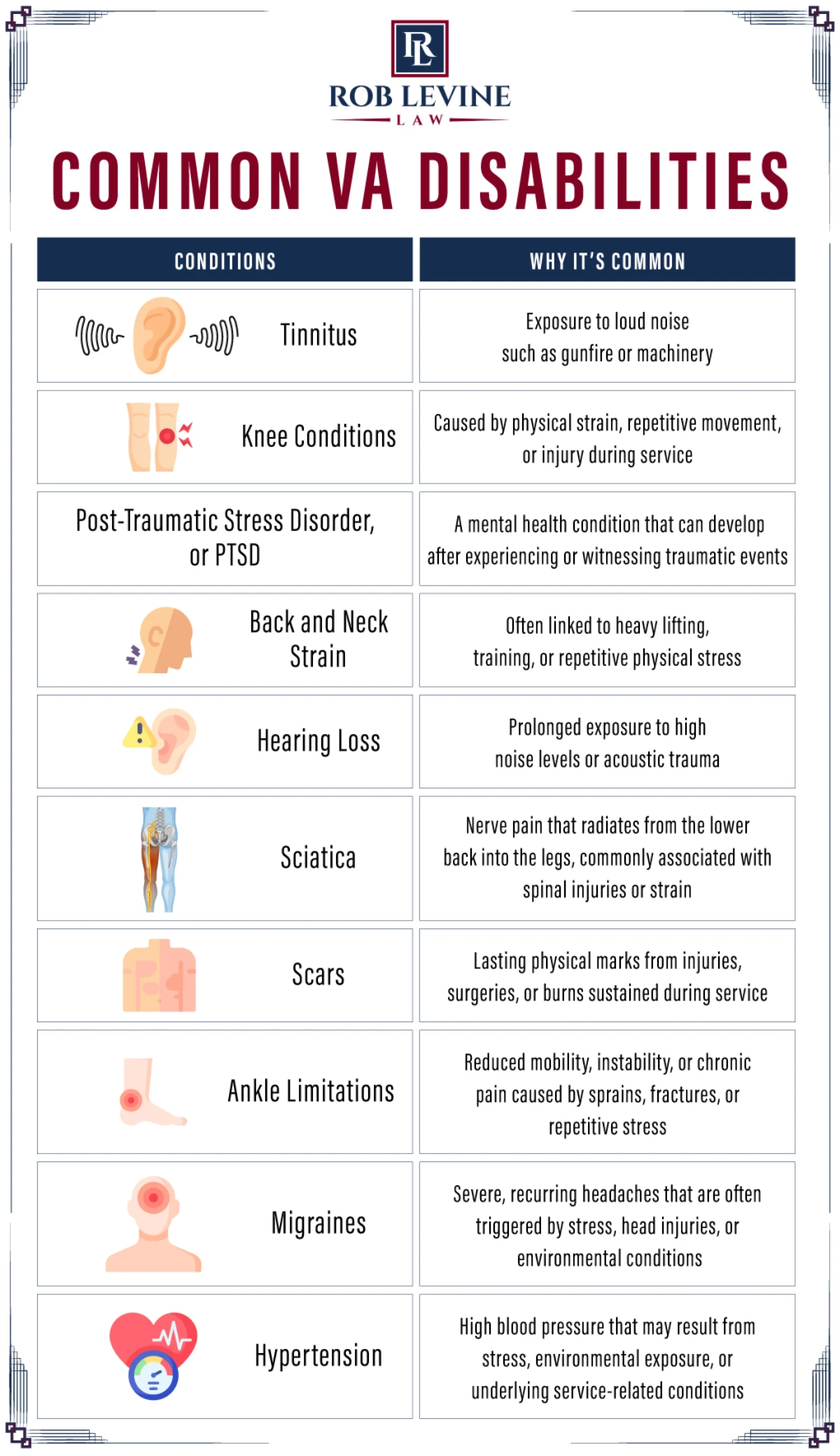
Below are some of the most common service-connected conditions that qualify for VA disability benefits:
- Tinnitus: A constant ringing or buzzing in the ears, often caused by exposure to loud noise such as gunfire or machinery
- Knee Conditions: Includes instability, pain, or limited motion caused by physical strain, repetitive movement, or injury during service
- Post-Traumatic Stress Disorder, or PTSD: A mental health condition that can develop after experiencing or witnessing traumatic events
- Back and Neck Strain: Chronic pain or limited mobility in the spine, often linked to heavy lifting, training, or repetitive physical stress
- Hearing Loss: Partial or total loss of hearing due to prolonged exposure to high noise levels or acoustic trauma
- Sciatica: Nerve pain that radiates from the lower back into the legs, commonly associated with spinal injuries or strain
- Scars: Lasting physical marks from injuries, surgeries, or burns sustained during service
- Ankle Limitations: Reduced mobility, instability, or chronic pain caused by sprains, fractures, or repetitive stress
- Migraines: Severe, recurring headaches that are often triggered by stress, head injuries, or environmental conditions
- Hypertension: High blood pressure that may result from stress, environmental exposure, or underlying service-related conditions
These conditions may be connected to service across different periods, including the Vietnam War, the Iraq War, the Afghanistan War, the Korean War, or World War II.
How to Use the VA Combined Rating Table
The VA uses a tool called the Combined Ratings Table, found at 38 CFR § 4.25, to calculate your final disability percentage. This table incorporates the same “whole person” concept and presents it in a grid format.
To use the table, you start by finding your highest rating in the left column. Then locate your next-highest rating along the top row. The point where those two numbers meet shows your combined value.
If you have more than two disabilities, the process continues step by step. You take the combined value from the first two ratings, then use that number to find the intersection with your next rating. The VA repeats the process until it accounts for all the conditions.
While the table may look complicated at first, it follows a consistent pattern.
How the VA Rounds Ratings
After combining your disability ratings, the VA does not assign a final percentage, such as 64% or 87%. Instead, ratings are rounded to the nearest 10%.
Under the nearest 10 rule, the VA rounds results ending in 0.4 or lower down, while rounding up results ending in 0.5 or higher. For example, a combined rating of 64% is rounded down to 60%, while 65% is rounded up to 70%.
This rounding system can significantly impact your monthly compensation. Even a small increase in your combined percentage can move you into a higher rating category.
Because of this, every percentage point matters when calculating your VA disability, especially as you get closer to the next rating level.
How Does VA Math Work for Multiple Disabilities?
Many Veterans receive ratings based on multiple conditions. On average, Veterans receiving compensation have about 5.3 service-connected disabilities, and that number can be even higher for certain groups, including Gulf War Veterans.
When combining multiple ratings, the VA starts with your highest disability percentage first and works downward. Each additional rating is applied to the remaining portion of your overall efficiency, not the original 100%. Because of this, later ratings often have a smaller impact on your combined percentage.
If you have disabilities affecting both arms or both legs, the VA applies a so-called bilateral factor, which adds an additional 10% to those paired conditions before combining them with your other ratings.
Examples of VA Math for Combined Ratings
Understanding VA math becomes easier when you see how it works step by step. The following examples show how multiple ratings are combined and how small percentages can impact your final rating.
Scenario 1: The Standard Combined Rating
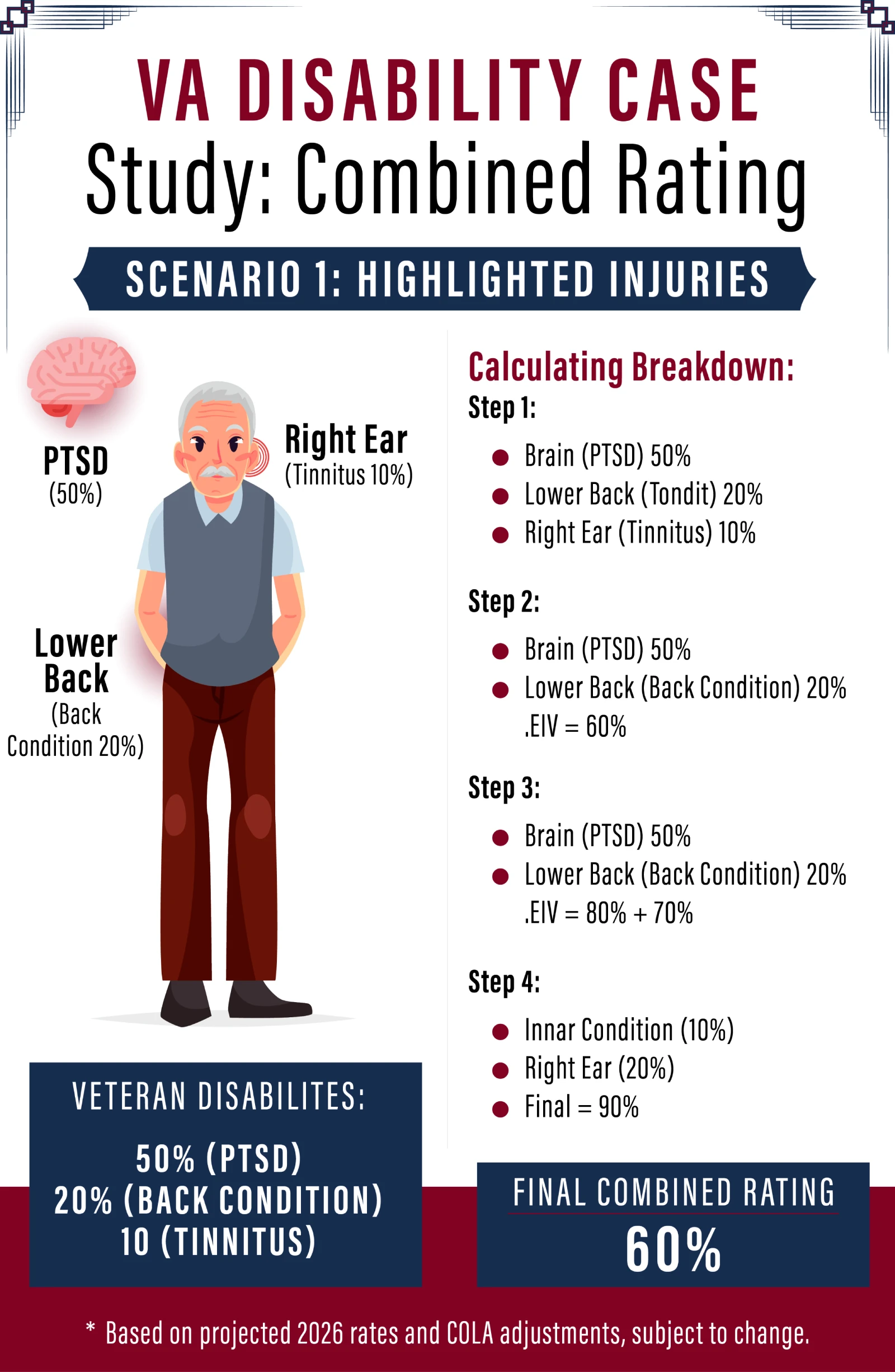
A Veteran has a 50% rating for PTSD, 20% for a back condition, and 10% for tinnitus.
First, subtract the 50% rating from 100%, leaving 50% efficiency remaining. Next, apply the 20% rating to that remaining 50%, which equals 10%. Adding that to the original 50% results in a combined disability rating of 60%.
Then, apply the 10% rating to the remaining 40% of efficiency. This equals 4%, bringing the total to 64%.
Because 64% ends in a 4, the VA rounds down to 60%.

Scenario 2: The Steep Hill
A Veteran has ratings of 70% for a TBI, 40% for a shoulder condition, 20% for a knee condition, and 10% for hearing loss.
Start by subtracting 70% from 100%, leaving a 30% efficiency level. Apply 40% to that 30%, which equals 12%, bringing the combined rating to 82%.
Next, apply 20% to the remaining 18%, which equals 3.6%, increasing the total to 85.6%. Then apply 10% to the remaining 14.4%, which equals 1.44%, bringing the total to 87.04%. Notice how the final 10% rating adds only a small increase.
Because 87.04% ends above 0.5, the VA rounds up to 90%.
Scenario 3: The Bilateral Factor
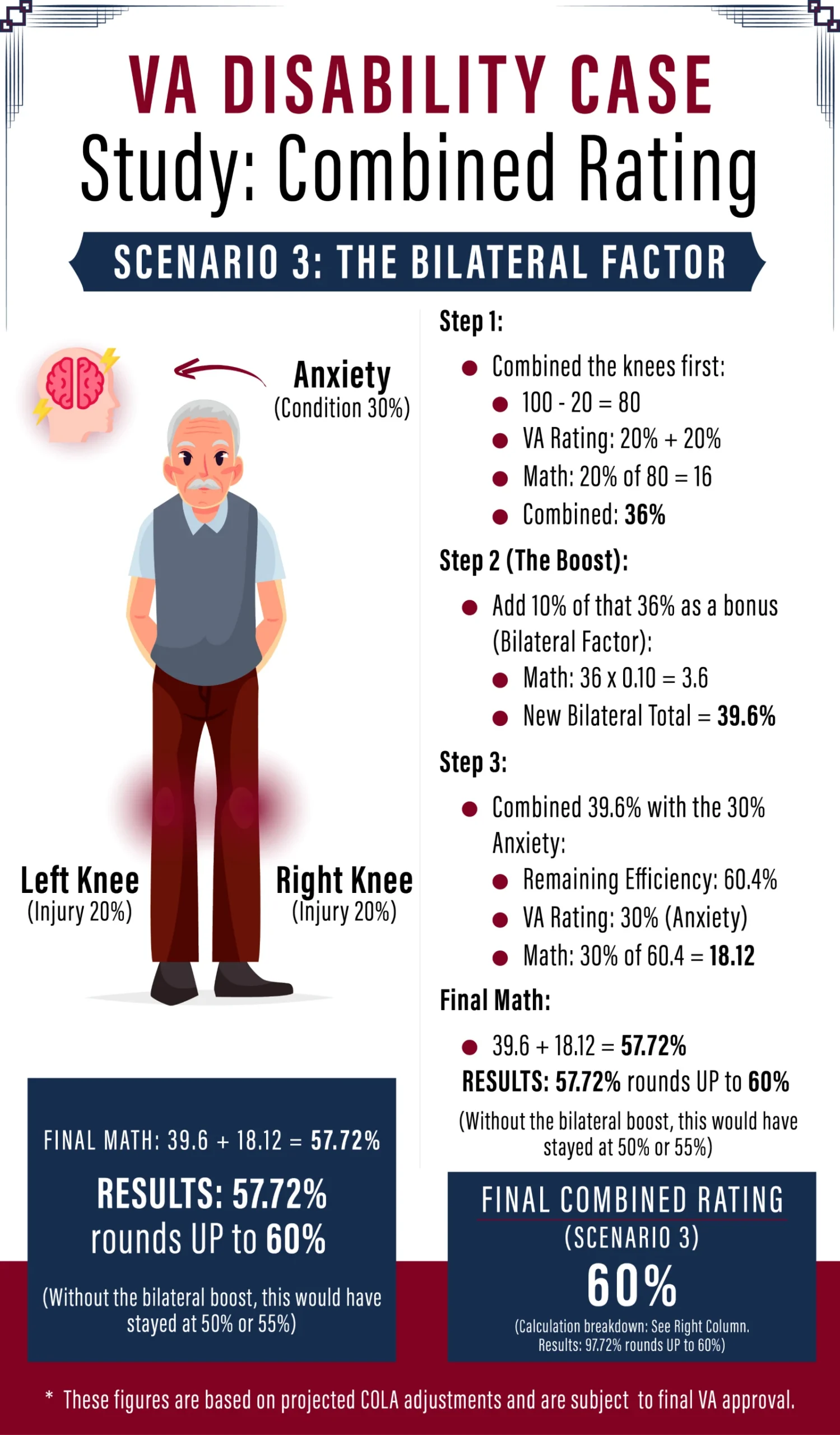
A Veteran has a 20% rating for the right knee, 20% for the left knee, and 30% for anxiety.
First, combine the two knee conditions. Subtract 20% from 100%, leaving 80% remaining efficiency. Apply the second 20% to that 80%, which equals 16%, resulting in a combined rating of 36%.
Next, apply the bilateral factor. The VA adds 10% of that 36%, which equals 3.6%, bringing the total to 39.6%.
Then combine that 39.6% with the 30% rating for anxiety. Apply 30% to the remaining 60.4%, which equals 18.12%, for a total of 57.72%.
Because 57.72% ends above 0.5, the VA rounds up to 60%.

Scenario 4: The Amputation and the Limb Cap Rule
This scenario introduces the amputation rule under 38 CFR § 4.68. The VA does not allow combined ratings for a single limb to exceed the rating assigned for amputation of that limb.
A Veteran has a 40% rating for amputation of the right leg below the knee, 20% for right knee instability, 10% for a right thigh muscle injury, and 30% for hypertension.
The VA first applies the limb cap. All conditions affecting the right leg are limited to the 40% amputation rating.
Next, subtract 40% from 100%, leaving 60% of the original efficiency. Apply the 30% rating for hypertension to that 60%, which equals 18%.
This results in a combined rating of 58%, which the VA then rounds up to 60%.
How VA Math Affects Your Disability Compensation
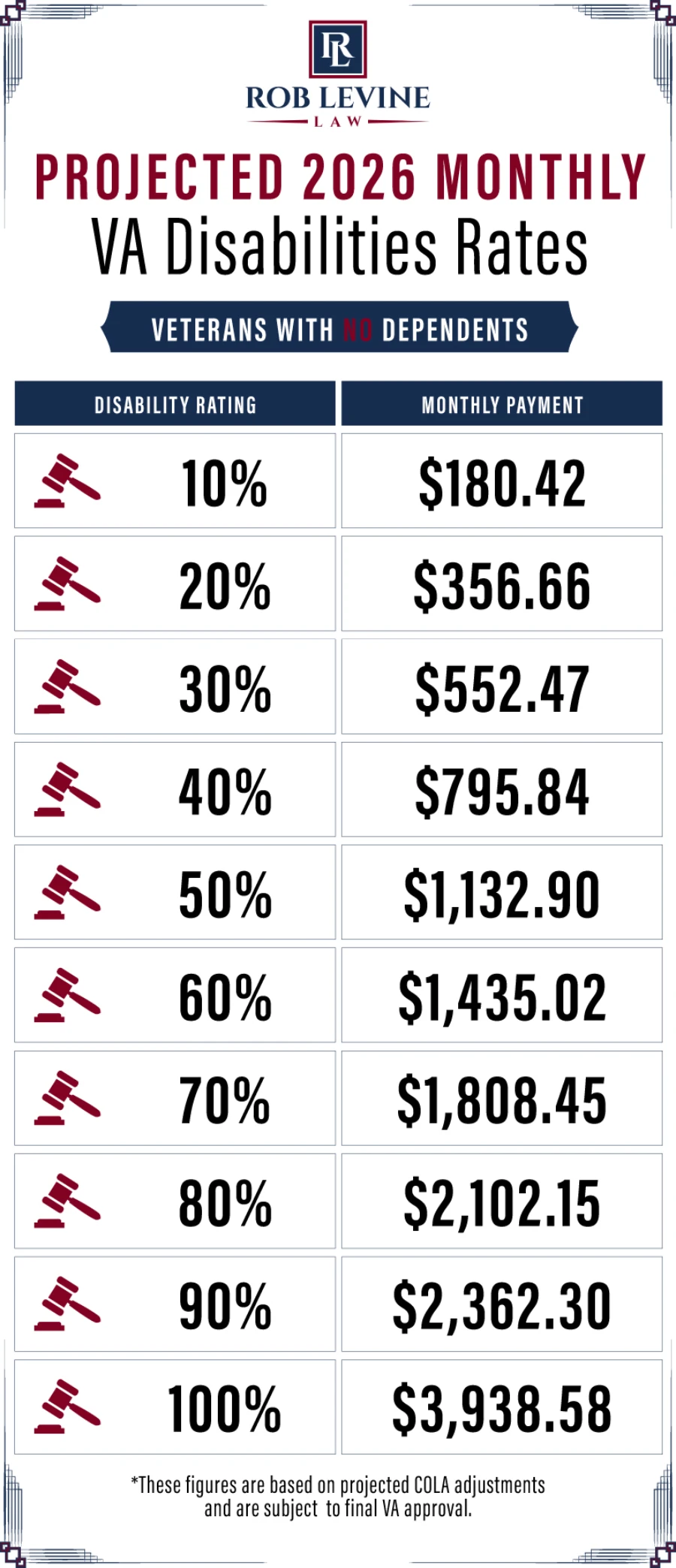
Your combined disability rating determines your monthly VA compensation. However, the VA provides compensation based on rating levels rather than exact percentages. Thus, it rounds your final combined rating to calculate the payment. This makes each percentage point important. A small increase in your combined rating can move you into a higher compensation level, while falling just below a threshold can keep you in a lower one.
Understanding how ratings are combined is important if you are trying to increase your VA rating, particularly when moving between levels such as 80%, 90%, and 100%. The difference between these levels becomes more noticeable at these higher percentages, with the jump from 90% to 100% representing one of the most significant changes in monthly compensation.
Why Is VA Math Important to Understand?
You have earned the benefits available to you through your service. However, VA math can become complex, especially when multiple conditions are involved. In some cases, a secondary condition or a small increase may be enough to move your rating into a higher category. When achieving a higher rating becomes difficult, options such as Total Disability Based on Individual Unemployability may be worth exploring.
A Veterans disability lawyer can help you understand the VA’s math, explain how your rating is calculated, show how small changes can affect your overall compensation, and help you pursue the full benefits you’ve earned. The Heavy Hitters® at Rob Levine Law bring over 75 years of combined experience handling Veterans disability claims, helping Veterans evaluate their ratings, understand their disability claim timeline, and identify next steps in the appeals process.
If you have questions about your rating, call (888) 791-9135 or contact us online to learn more. We are available 24/7.